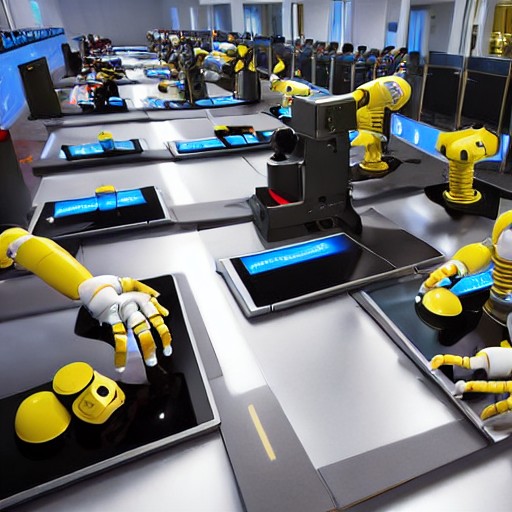
What happens when AI coding agents are given access to robotic arms and computing resources? They learn to cut zip ties and install GPUs, according to recent experiments. This breakthrough, facilitated by a new harness called ENPIRE, suggests that robots could soon train themselves in various tasks without human intervention.
The framework allows AI models to interact with physical tools while providing memory and feedback mechanisms. Developed by researchers at Nvidia’s GEAR lab, alongside Carnegie Mellon University and the University of California, Berkeley, it's a significant step towards self-improving robotics.
Jim Fan, director of AI at Nvidia, described the scenario where 'a part of our NVIDIA GEAR lab now self-improves tirelessly overnight,' hinting at potential benefits for the company in allowing its founder and CEO Jensen Huang to take a holiday.
The ENPIRE harness includes modules that enable automatic task verification, policy refinement, real-world testing, and logging analysis. It was tested with AI agents like OpenAI’s Codex, Anthropic’s Claude Code, and Moonshot AI’s Kimi Code. These teams independently developed algorithmic approaches, validating their success through repeated cycles of self-directed experiments.
The implications are vast: a future where robots not only perform tasks but also learn and improve them autonomously might soon become reality. But it's not just about efficiency; it raises questions about the role of humans in technological progress.