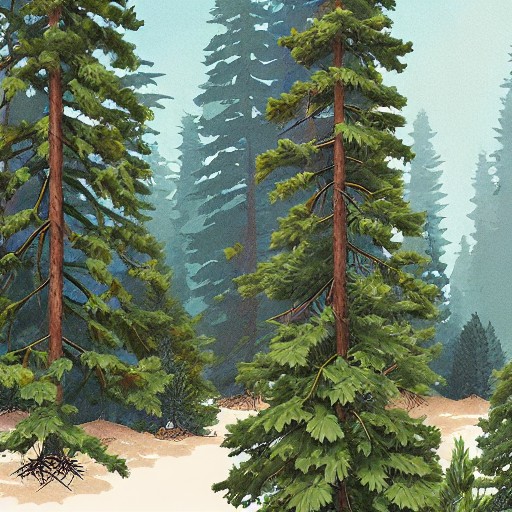
While visiting the Lebanese mountain town Dhour El Choueir, I couldn't shake off a painting and a poem I had translated two decades earlier. The Lebanese painter Moustafa Farroukh’s watercolor ‘A Group of Pines in Bekfaya’ and the Armenian poet Vahan Tekeyan’s sonnet ‘To a Lebanese Pine Tree’ resurfaced with poignant clarity. These works, created in the aftermath of Lebanon’s tumultuous history, serve as a testament to the resilience of a nation.
The poem begins with history lodged in the body. ‘Your pain unfolds from the past,’ Tekeyan tells the tree. The first wound appears low on the trunk, the lost branch resembling a human limb. Before long, the instrument of amputation appears explicitly: the saw. The mutilations accumulate, with the higher branches sprouting and thickening, adorned with ‘translucent tresses.’ Yet, those branches too bear ‘fresh traces of the saw.’
The injured body becomes a genealogy. Its branches are its ‘grandchildren and great-grandchildren, dead too soon.’ The ancestor remains standing as its descendants disappear around it. Tekeyan then reverses the natural order of generations: the ancestor becomes the grave of its descendants, ‘whose open grave you have become beneath the skies.’ Everything in the sonnet seems to carry us toward grief. Until it doesn’t. ‘But you do not at all inspire,’ Tekeyan writes, ‘any thought of mourning.’ And he tells us why: ‘You ever bring forth new life.’
For all the Armenian resonances of Tekeyan’s wounded tree, the poem is emphatically Lebanese. Reading it in Lebanon in August 2026, I was struck less by what the pine might stand for than by how closely its contradictions seemed to belong to the country around me. The pine tree’s story is a metaphor for Lebanon’s enduring spirit, a nation that has faced countless challenges and yet continues to thrive.