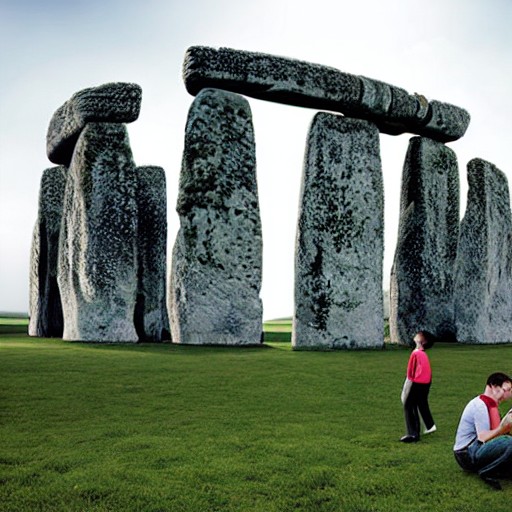
Once thought to have originated in Wales, like the rest of Stonehenge's bluestones, the monument’s altar stone has now been traced through geological fingerprinting to Scotland. The question of how this massive megalith made the 435-mile journey from there to Salisbury Plain is now being explored by scientists at Curtin University and experts from Sheffield Hallam University, the University of Sheffield, Wessex Archaeology, and the University of Bristol.
Stonehenge was built in stages between around 3,000 BC and 1,500 BCE. The altar stone is believed to have been placed during the second construction phase between 2,620 and 2,480 BCE. Geological evidence confirms that sandstone boulders came from the Marlborough Downs, 20 miles away, while smaller dolomite bluestones were quarried in the Preseli Hills in southwest Wales, 180 miles to the northwest.
The Curtin University team has ruled out glacial transport of Stonehenge’s bluestones, concluding that they were almost certainly carried by human labor alone. Now, building on their previous research, the Curtin and Sheffield Hallam University scientists postulate that the movement of the altar stone may have involved a combination of human and glacial transport.
After studying ancient ice flows, the researchers believe that a glacier carried the altar stone from the Orcadian Basin in Northeast Scotland to Dogger Bank—a prehistoric landmass connecting Britain to mainland Europe now submerged under the North Sea—during Britain’s last ice age between 33,000 and 11,700 years ago. The stone would still have needed to be moved hundreds of kilometers by people.
“Transporting a stone of this size over such a long distance would have required planning, coordination and a deep understanding of the landscape—not to mention tremendous determination,” says co-lead author Dr Anthony Clarke from Curtin’s School of Earth and Planetary Sciences. Sheffield Hallam University's Dr Remy Veness notes, “What is exciting about these findings is that they could imply that the people of Doggerland attached cultural significance to the Altar Stone long before it was incorporated into Stonehenge.”