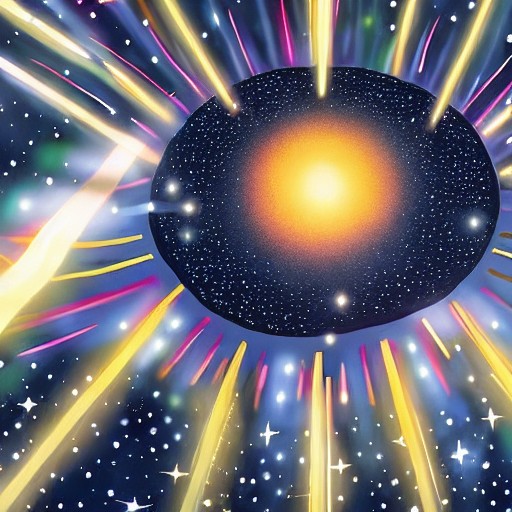
In August, astronomers unveiled a truly outlandish find: a 'black hole star.' This celestial object, initially spotted as a mysterious red dot by the James Webb Space Telescope, defies the usual definitions of stellar and black hole physics. Its intense brightness and unique spectral properties suggest a new category of cosmic phenomenon, potentially rewriting our understanding of stellar evolution.
This black hole star, named for its size and luminosity, challenges conventional theories, offering a window into the early universe. Its discovery could lead to breakthroughs in astrophysics, challenging our current models of star formation and black hole behavior.
Elsewhere, the world of waste management is getting a microbial makeover. Scientists are harnessing the power of bacteria to break down plastics and transform them into edible cookies. This innovative approach not only addresses the plastic crisis but also offers a practical solution, turning waste into a delicious snack. The future of sustainable living might just be in your kitchen!
Meanwhile, the underwater world is whispering secrets of the cosmos. Whales, it turns out, are not just singing for fun. Their calls are linked to Einstein's special theory of relativity, suggesting a deep connection between the speed of sound in water and the relativity principle. This discovery bridges the gap between marine biology and theoretical physics, opening avenues for interdisciplinary research.
Finally, in a bid to understand the complex world of plant biology, researchers have uncovered a fascinating phenomenon: avocado tree flowers change sex during the day. This dynamic behavior could have significant implications for agriculture, potentially leading to more efficient pollination and increased yields.