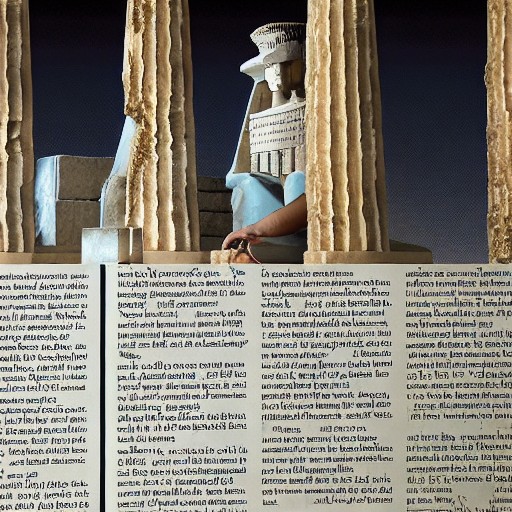
A new AI tool, Apollo, is set to revolutionize the study of ancient Greek papyri. Developed by the Austrian Academy of Science in partnership with French AI lab Mistral and technology services firm Sail Reply, Apollo is designed to help scholars fill in gaps in damaged documents, accelerating the research process. The model, trained on 600 million historical Greek words, promises to streamline the identification of relevant papyrus fragments, potentially revealing hidden details about historical events and practices.
While some academics are excited about the potential of Apollo to speed up the painstaking reconstruction work, others are cautious. Stephen Colvin, a professor of classics and historical linguistics at University College London, notes that despite its promising capabilities, Apollo is unlikely to change the broad understanding of the ancient world. Many papyri are mundane—personal letters, marital contracts, civil service papers—and thus not likely to yield new masterpieces by Sophocles. However, Apollo could help uncover new details about life in antiquity and substantiate existing scholarly assumptions.
The model’s ability to propose word options for scholars to select between is a key feature. Anna Dolganov, a historian and papyrologist at the Austrian Academy of Science, explains that Apollo will supplement Homeric Greek when it sees Homer and use Doric dialect when appropriate. This ensures that the historical record remains accurate, even as the tool speeds up the research process.
Armand D'Angour, a professor of classical languages and literature at the University of Oxford, believes that Apollo could be a game-changer. ‘If I had a machine telling me, “Here are the three possible words that could fit into that gap,” it would speed up matters considerably,’ he says. If Apollo is successful, the same technique could be applied to other ancient languages or any academic discipline that would benefit from the distillation and indexing of a large corpus of material. AI has had notable success in other areas, such as solving a 200-year-old math problem, which demonstrates its potential.
The concern about potentially polluting the historical record with errors is valid, as noted by the AI's developers. Human competence needs to remain, as Apollo is designed to propose word options for scholars to select between. If we become totally reliant on AI transcriptions and interpretations of historical material, that’s when the problems start.