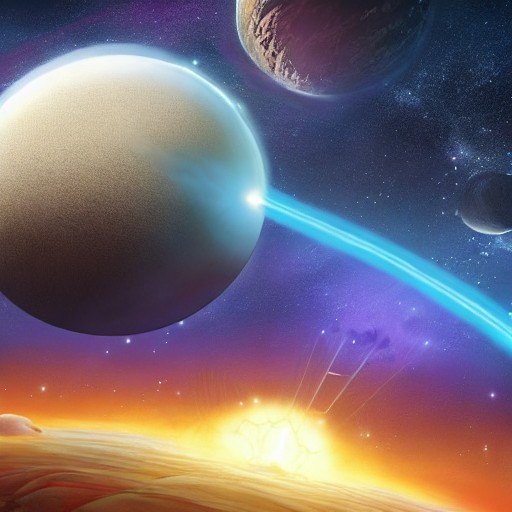
Venus, Earth’s near-twin in size and mass, may have quietly snatched up its own moon. A new study suggests that this moon was gradually pulled in by Venus’s gravity and gravitational pull, ultimately being consumed in its entirety. This process, driven by the planet’s sluggish rotation, presents a cosmic tale of planetary evolution.
Unlike Earth, with its 24-hour day, Venus takes 243 Earth days to rotate. This slow spin, combined with its strong gravitational field, creates a unique environment where any satellite is more likely to be drawn inward. Through complex computer models, scientists have demonstrated that under various conditions, a moon would spiral towards and eventually be absorbed by Venus.
The findings also hint at the possibility that Venus once had a moon. However, due to Venus’s active volcanic and tectonic activity, any evidence of this has likely been erased. Seismological surveys, if possible, could uncover clues hidden beneath the planet’s surface. This consumption of moons could also offer insights into Venus’s past, including whether it ever had the right conditions for life.
These results have significant implications for exoplanet research. Planets with slower rotations are less likely to retain moons. This means that when searching for Earth-like exoplanets, their rotation speed could be a critical factor in determining their potential to support life.