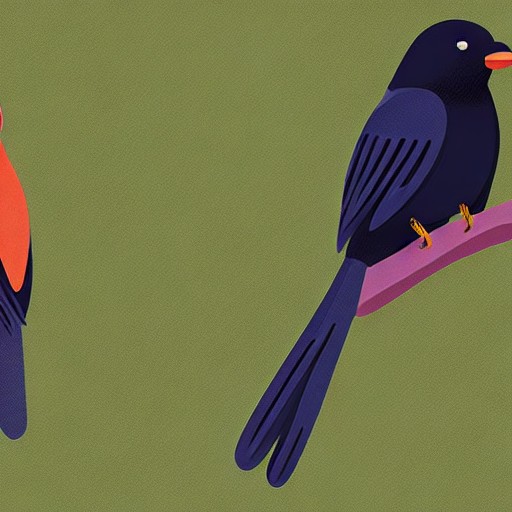
In a groundbreaking experiment, researchers discovered that crows can evaluate visual information twice as quickly as their primate counterparts. By using a random-dot-motion task, scientists observed that carrion crows made decisions using the same mathematical logic as monkeys, but did so in half the time. This finding challenges our understanding of how different brain structures can lead to similar decision-making processes.
Professor Andreas Nieder, from the University of Tübingen, and his colleague Philipp Schmidbauer, put two hand-raised crows through the task. The crows had to peck at targets to indicate the overall direction of a cloud of moving dots. Correct answers earned them a mealworm, which they seemed to take with the same seriousness as any experiment.
The task varied the number of dots moving coherently, from 81% to just 3%, making it progressively harder for even the clever crows. Despite their unique brain structure, the crows matched the performance of primates, showing that their visual decision-making process is remarkably similar. This suggests that the core mechanisms of decision-making might be more universal across species than previously thought.
The speed with which crows can make decisions challenges the conventional wisdom that primate brains, with their neocortex, are more efficient. This could lead to new insights into how our own brains work and potentially inspire more efficient algorithms for artificial intelligence. If crows can make decisions twice as fast, perhaps there's a lesson in their cognitive shortcuts for us all.






