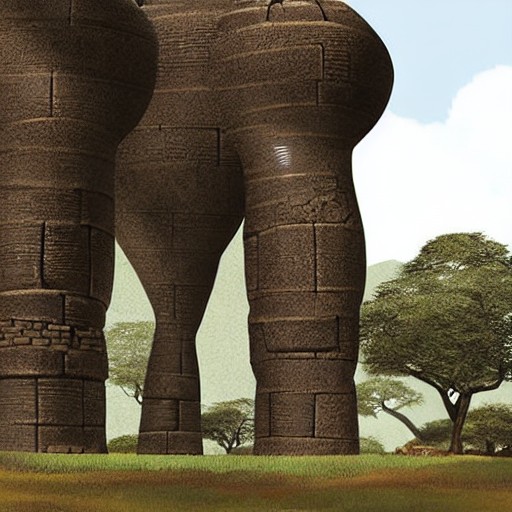
It’s not easy to extract iron from its ore. But the peoples of the ancient city of Great Zimbabwe—the capital of a thriving kingdom in southern Africa between 1000 to 1700 AD—were masters. At sites near the city’s stone ruins, clusters of iron-smelting furnaces survive today as mounds of rubble. Some of the furnaces were nearly an adult’s arm span in width, with walls thick and strong to contain the heat of more than 2,100° Fahrenheit needed to smelt iron. Unlike other furnaces that required workers to force air into them with bellows, these were designed to suck air in, then out through a chimney, no human labor required. This would have made it significantly easier to produce the iron, which was fashioned into hoes, axes, and arrowheads.
The number and size of these furnaces, together with the use of natural-draft technology, indicate intensive and technologically sophisticated iron production. Scientists are extremely interested in the peoples who created this and other iron-powered societies across eastern and southern Africa. Research points to an adaptable and innovative group from western Africa as the masterminds. Known as Bantu speakers, these communities began gradually expanding across the continent’s southern half, starting from 6,000 to 4,000 years ago. In doing so, they introduced a fundamentally new, sedentary way of life—characterized by farming, raising livestock, pottery-making, and metalworking—to regions previously dominated by hunter-gatherer communities.
This migration transformed not only the region’s history and technology, but also its languages: Today, around 350 million Africans speak one of roughly 500 distinct Bantu tongues, from southern African Zulu to eastern African Swahili. And at least as many Africans—as well as many African Americans and Afro-Latinos—carry Bantu ancestry in their DNA.






