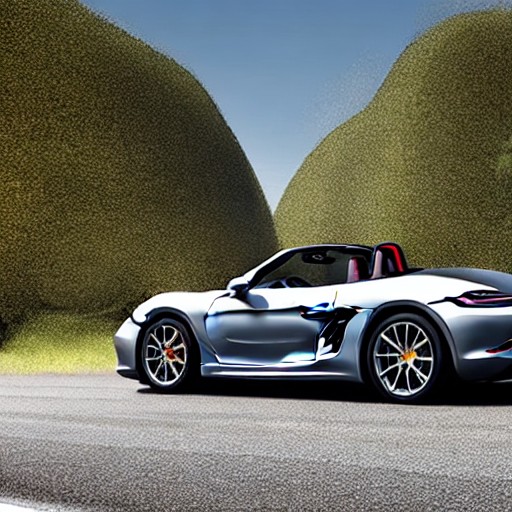
It wasn’t until I was stuck in traffic on the way back from a run up and down some canyon roads that I realized just how low Porsche’s upcoming all-electric 718 Boxster truly is. I was idly looking around at the other cars, doing the math on the EV adoption rate in this small sample of Los Angeles gridlock (roughly 50 percent, impressively) when I noticed that I was eye-level with a Tesla Model Y door handle.
That’s not particularly low for a sports car, but it’s practically unheard of for an EV. Nearly all modern electric cars are built atop a skateboard-style battery pack, a stack of cells that elevates the seating position by a good 3 inches. In these SUV-heady days, that’s usually not a problem, possibly even an advantage. But, in a car like this, the closer you can get your keister to the road, the greater the sensation of speed.
So, for the company’s first all-electric sports car, the 718 Boxster that will be fully revealed next year, Porsche engineers put the battery pack behind the driver. That powers a single motor spinning the rear wheels and creates a driving experience that both honors the simple joy of motoring in a mid-engined Boxster while pushing the 718 to new heights of power and performance.
Mid-engined? Mid-batteried. That EV battery layout, stacked behind the two-seat cabin rather than sandwiched below it, isn’t novel. It’s the same setup that Tesla used on the original Roadster back in 2008. Back then it was done for cost reasons as much as anything, enabling Tesla to repurpose a Lotus chassis meant to hold an internal combustion engine in the middle.
For Porsche’s new Boxster (and the Audi Concept C, which is built on the same platform), that pack enables the low seating position and also delivers a rearward weight bias (40:60 front/rear) that’s in keeping with the last-generation 718 Boxster, the internal combustion model killed by EU cybersecurity regulations last year.






