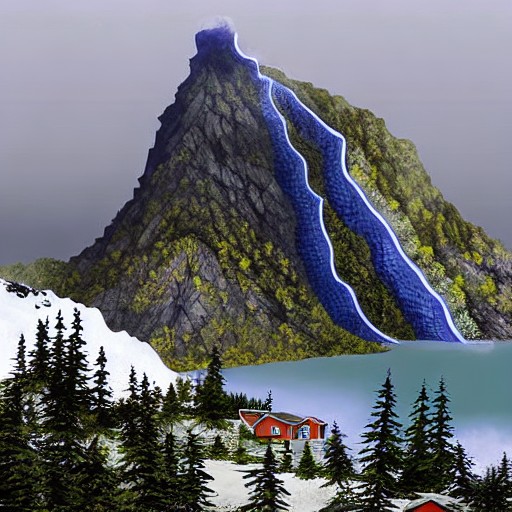
At 5:26 am local time on August 10, 2025, a massive wedge of rock with a volume of at least 63.5 million cubic meters detached from a mountain above Alaska's Tracy Arm fjord. The falling rock plummeted into the deep waters at the terminus of the South Sawyer Glacier and caused an initial 100-meter-high breaking wave that tore across the fjord at speeds exceeding 70 meters per second.
When this wave hit the opposite shoreline, it surged up the steep rocks to a height of 481 meters above sea level. “It was the second highest tsunami ever recorded on Earth,” says Aram Fathian, a researcher at the University of Calgary and co-author of a recent Science study that reconstructed this event in detail. “But until now, almost nobody heard about it because it was a near-miss event,” he adds.
Landslide megatsunamis are often more localized but also way more violent than earthquake-generated tsunamis. When millions of tons of rock suddenly fall into a confined body of water like a narrow fjord, the variation in water depth and the direct displacement of the water column produce extremely high waves. Since 1925, scientists have documented 27 such events with runups exceeding 50 meters.
The source of the 2025 Tracy Arm tsunami was a steep rock wedge on the northern side of the fjord. Its headscarp, the uppermost boundary of a landslide or rockfall, sat roughly 1,025 meters above sea level. For centuries, the structural integrity of this slope was maintained by a massive wall of ice known as the South Sawyer Glacier. But South Sawyer, like many other glaciers in the Stikine Icefield, has been in a state of retreat due to the warming climate.
The event highlights the increasing vulnerability of coastal areas to natural disasters, particularly in regions where glacier melt is accelerating. The next time such an event occurs, there might not be so much luck on our side.