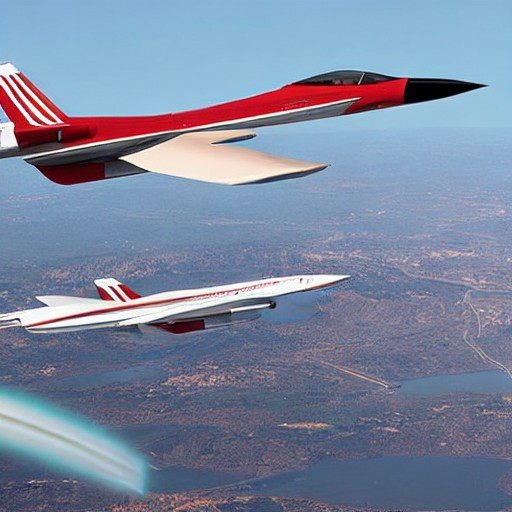
The Federal Aviation Administration (FAA) has proposed lifting a 53-year-old ban on commercial supersonic flights over the United States, paving the way for quieter supersonic airliners to take to the skies. The new rule would replace the prohibition with an interim 'noise-based' certification standard, requiring sonic boom overpressure at ground level to remain below 0.11 pounds per square foot.
Back in 1973, after military tests caused disturbances, the FAA banned civil supersonic flights. Now, with Boom Supersonic’s XB-1 aircraft demonstrating quiet Mach cutoff flights, the door is open for a new era of commercial supersonic travel. However, not everyone is convinced; Dan Rutherford from the International Council on Clean Transportation has his doubts about the new standard.
The old Concorde created a sonic boom overpressure equivalent to 1.94 pounds per square foot during its flights between 1976 and 2003, while NASA suggests some public reaction might be expected at values between 1.5 and 2 pounds of overpressure. Yet, a loudspeaker blast can reach up to 144 pounds without causing injury, making the new standard seem quite mild.
However, the proposal has sparked debate: critics argue that the overpressure metric doesn’t actually measure loudness or annoyance, as UN experts found in 2014. This raises questions about whether a quieter flight truly means better for passengers and communities below.