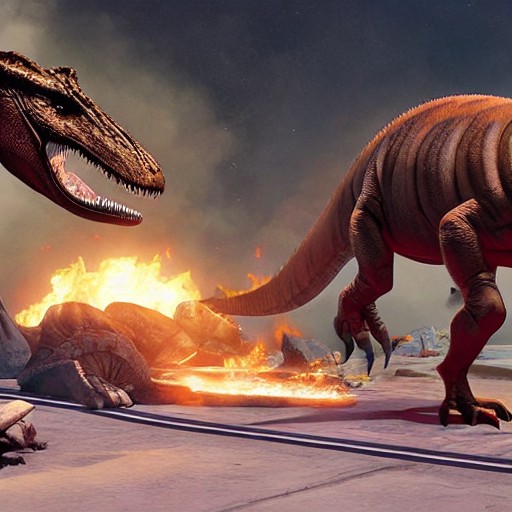
Some 66 million years ago, an asteroid impact wiped out three-quarters of all plant and animal species on Earth, most notably taking down the dinosaurs. But exactly how that impact caused those extinctions has been the subject of fierce debate. According to a new paper published in the Journal of Geophysical Research: Biogeosciences, the impact would have produced an immense cloud of dust that superheated the upper atmosphere, charbroiling living organisms unable to take shelter and igniting widespread wildfires.
As previously reported, the most widely accepted explanation for what triggered that catastrophic mass extinction is known as the “Alvarez hypothesis,” after the late physicist Luis Alvarez and his geologist son, Walter. In 1980, they proposed that the extinction event may have been caused by a massive asteroid or comet hitting the Earth. They based this conclusion on their analysis of sedimentary layers at the Cretaceous-Paleogene boundary (the K-Pg boundary, formerly known as the K-T boundary) found all over the world, which included unusually high concentrations of iridium—a metal more commonly found in asteroids than on Earth. (That same year, Dutch geophysicist Jan Smit independently arrived at a similar conclusion.)
Since then, scientists have identified a likely impact site: a large crater in Chicxulub, Mexico, in the Yucatan Peninsula, first discovered by geophysicists in the late 1970s. The impactor that created it was sufficiently large (between 11 and 81 kilometers, or 7 to 50 miles) to melt, shock, and eject granite from deep inside the Earth, probably causing a megatsunami and ejecting vaporized rock and sulfates into the atmosphere. It has been estimated that the impact would have released energy over a billion times higher than the atomic bombs dropped on Hiroshima and Nagasaki in 1945.