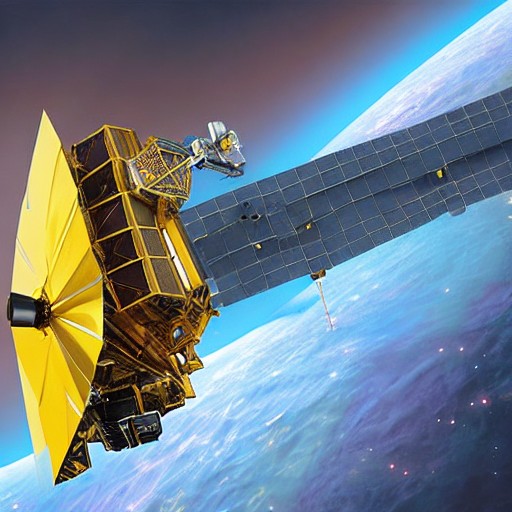
When Charlotte Mason ponders cosmic mysteries, she likes to doodle. “I am quite a visual person,” she said. “I usually draw a lot of pictures trying to understand what's going on.” As an astrophysicist at the Cosmic Dawn Center in Copenhagen, Mason has lately been filling pages with sketches of ‘little red dots,’ perplexing objects discovered by the hundreds in images from the James Webb Space Telescope (JWST).
These dots have emerged as one of many thrilling mysteries that have arisen from JWST’s observations of the early universe. Other puzzles include black holes that seem impossibly large for their age, and ancient galaxies that defy what we thought we knew about the first billion years after the Big Bang.
Mason thinks there may be more to these cosmic enigmas than meets the eye. She recently analyzed the spectrum of light emitted by one little red dot. If the dense-cloud picture is correct, then some of the light should have been altered from passing through the gas—but that’s not what they saw. “Now what do I do? Start again,” Mason said, drawing a new diagram with holes in the clouds surrounding the black hole.
Scientists like Greene are eagerly piecing together JWST's glimpses of the ancient cosmos to create a clearer picture of our universe’s beginnings. The story of black holes has become more complicated thanks to JWST, which keeps spotting ancient black holes that are too big to explain with established theories—much too big.
In the modern universe, black holes form when the core of a massive star runs out of fuel and collapses. Considering the first stars were quite massive, they could have left behind black hole seeds of up to about 100 solar masses, Greene said. “We know that happens, but it’s really, really hard to get them to a billion so quickly,” she added.